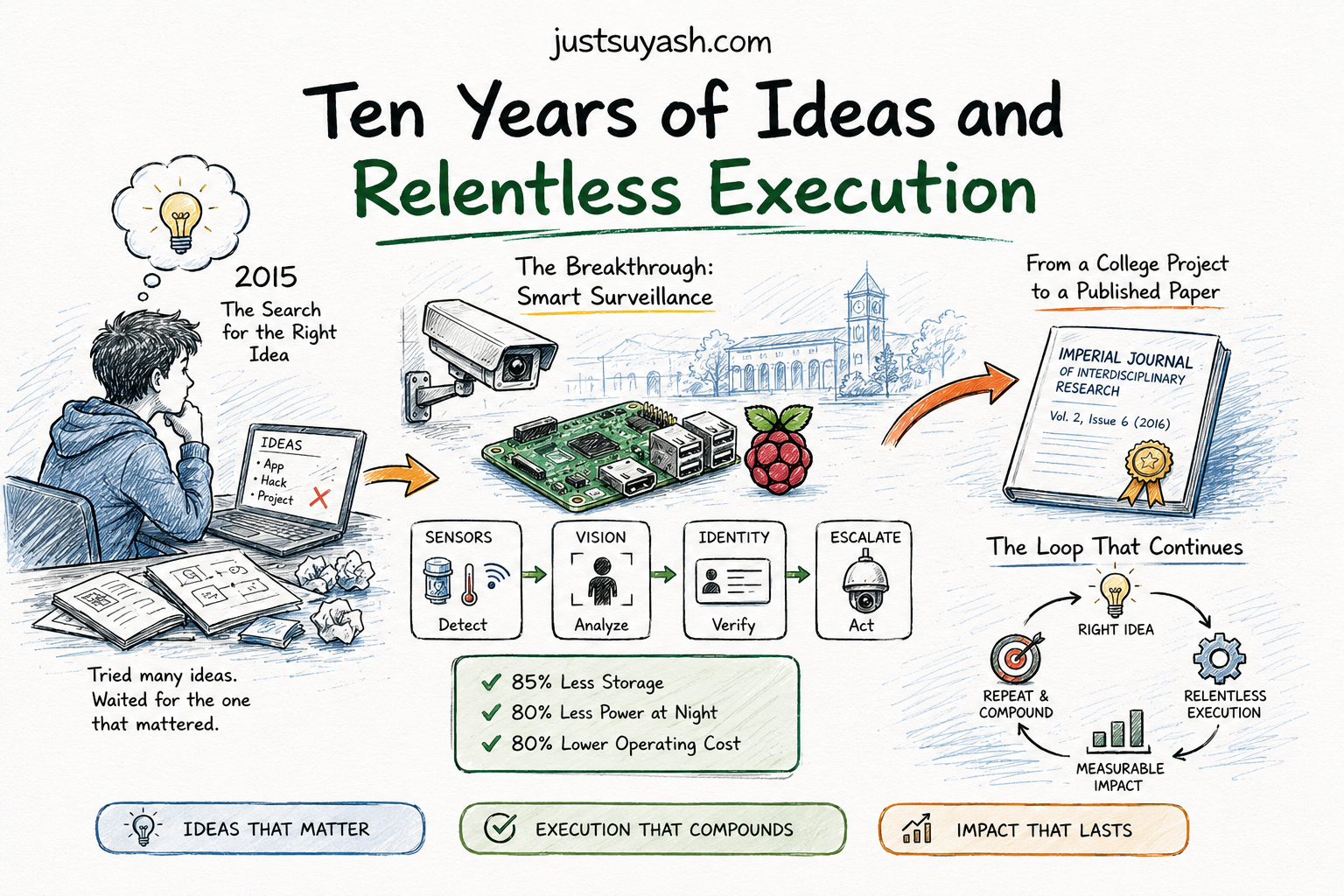
There's a popular line that ideas are cheap and only execution matters. It sounds wise until you actually build something and realize the hardest part was never the wiring or the code — it was knowing what was worth wiring in the first place. For the last ten years, my career has basically been one long experiment in that direction: tinker with all the ideas, find the one that resonates and is numerically defensible, then execute it relentlessly. This story is where that pattern started.
2015. Final-Year Project Season.
Everyone around me was building safe, template-friendly projects — the kind of apps that tick the rubric, get demoed once, and die on a USB drive. Data science and machine learning were just starting to show up on our radar. A couple of seniors had played with it, but most of my batch was ignoring it. I decided I wasn't going to submit anything unless it felt genuinely interesting.
People told me I was overthinking it. I'd be late. My grades might take a hit. The unwritten rule of the college-project game was simple: pick something fast, build something adequate, move on. I chose to break that rule. If I couldn't find a good idea, I'd rather sit in the discomfort and wait than rush out something forgettable. That wasn't rebellion for its own sake. It was a bet that choosing the right problem mattered as much as — and probably more than — how elegantly I solved it.
For a while, that bet looked bad. I had half a dozen half-projects on my laptop: half-baked apps, small hacks, ideas that sounded clever and died in implementation. None of them felt worth betting my final-year project on. Then I got pulled deeper into machine learning and computer vision. The idea that a model could look at an image and tell you what was in it was fascinating on its own — but I didn't want to stop at “this is cool.” I wanted it to collide with something real.
The CCTV Cameras I'd Ignored for Years
One day I was walking across campus and finally noticed something I'd effectively ignored for years: the CCTV cameras. They were always on. Every corridor, every gate, every lobby, recording 24/7, whether or not anything actually happened. At night, those cameras were still burning through electricity and storage to capture hours of empty footage. Security got their “coverage,” but most of that coverage was just expensive silence.
That observation was the real idea: the problem wasn't that the cameras were bad; the problem was that they were dumb. They couldn't decide when to care. So why not make the system think before it records?
Building a Brain Between “Motion” and “Record”
Straightforward execution wasn't going to be enough. My teammates — Aakash Dave, Pranav Sinha, Suraj Pramod Patil — and I designed what we started calling a sporadic surveillance system for high-clearance zones. Instead of cameras running constantly, we built a layered decision pipeline:
All of that ran on a Raspberry Pi with image-processing software, connected to a central server. Same physical cameras, same campus, but now there was a brain between “motion” and “record.”
The Numbers Made It Obvious
| Metric | Before | After |
|---|---|---|
| Storage usage | Continuous — every second stored | ↓ ~85% (event-based only) |
| Night-time power consumption | Cameras burning 24/7 | ↓ ~80% |
| Security operating cost | Baseline | ↓ ~80% — zero camera replacements |
For a student project, that's not just a nice demo. That's a material improvement in how a real system runs.
The Serendipitous Part
We weren't chasing publication. We didn't build the project thinking, this is going to be a paper. We built it because the idea felt right and the impact was obvious. My professor saw the system, got properly excited, and pushed to get it published. That's how it ended up as “Security and Sporadic Surveillance System at High Clearance Zone Using Sensor Activated Camera” in Volume 2, Issue 6 (2016) of the Imperial Journal of Interdisciplinary Research.
My reaction was very sophisticated and academic: damn bro, we published a paper.
Looking back now, this whole thing feels less like a one-off college story and more like the prototype for how I still work. In 2015, edge-based, event-triggered vision wasn't a buzzword. Today, cameras that only “wake up” and reason when something's happening are embedded in everything from smart doorbells to industrial safety systems. As an undergrad with a Raspberry Pi and a handful of sensors, I accidentally built a rough version of a cornerstone of many successful businesses — and that in itself is the reward.
Where the Ideas vs. Execution Debate Falls Apart
People don't usually fail because they're incapable of executing. They fail because they execute the first idea that shows up. They wire up projects that were never worth wiring. Saying no to a dozen safe, acceptable final-year ideas and holding out for the one that actually deserved the effort cost me time and a bit of comfort, but it taught me a pattern I still use:
- Be ruthless about the idea.
- Be relentless about the execution once you've found it.
- Measure the impact so you know it wasn't just shiny.
Ten years later, whether I'm shipping something like ClinicOS or building experimentation systems in large companies, that loop keeps repeating. I'm not interested in being “the idea guy” or “the execution guy.” I'm interested in stacking the right idea with the right execution and watching the impact compound.
About the author
Suyash
I build software that solves real problems — currently ClinicOS, a clinic management system I designed sitting in my brother's clinic, watching him work. When I'm not writing code, I'm behind a camera shooting landscapes, working a bag, swinging a steel mace, or on a yoga mat. The through-line across all of it: discipline, craft, and an obsession with doing things right.