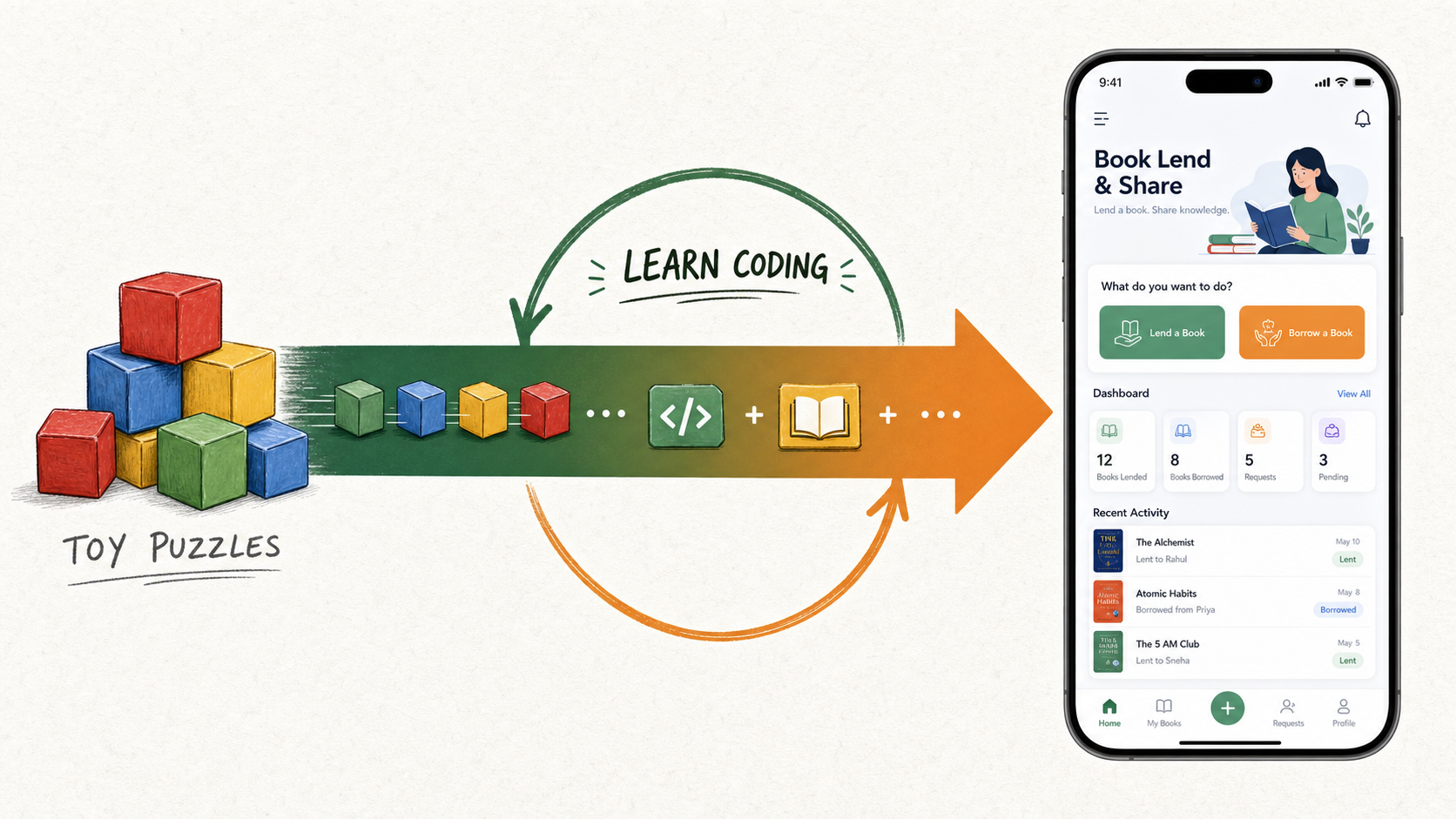
Before the surveillance project. Before the published paper. Before I called myself anything close to an engineer, there was a second-year project and a simple, stubborn refusal to build something boring.
Project Season, Round One
It was my second year. Project season, round one. And just like it would happen later, everyone around me reached for the safe options. A bus booking system. An attendance tracker. The same handful of templates that get rebuilt every semester, demoed once, and forgotten. Solid enough to pass, interesting to no one — including the people building them.
I didn't want that. I wanted to build a little library — an app where people could lend and borrow digital books, PDFs and e-books, from each other. It wasn't flashy. It wasn't going to win a hackathon. But it was a real thing that real people could actually use, and that was enough to make it worth my time. That's the same filter I'd apply later with the cameras, just with lower stakes and a lot less skill.
The Part I Don't Usually Lead With
Because here's the part I don't usually lead with: I couldn't really build anything. Sure, I could solve small coding puzzles — write a for loop, work through a textbook problem — but I had never written an actual script, let alone built a real app. Puzzles and products are two different worlds, and I was standing firmly on the wrong side of that line. I had the idea and the conviction and almost none of the ability to ship it. On paper, that should have been a reason to pick something easier. Instead, it became the whole point.
So I did two things. First, I pulled in friends who could code to help me build it — which taught me early that a good idea is a magnet; people will lend you their skills if the thing is worth building. Second, and more importantly, I refused to just be the “idea guy” while everyone else typed. I started actually learning. Line by line, bug by bug, borrowed function by borrowed function.
The Project as a Crash Course
The project became my crash course. Every feature I wanted forced me to learn the thing that made it possible. I wasn't studying to pass an exam; I was studying because the app in front of me refused to work until I understood it. That's a completely different kind of motivation, and it moves you fast.
By the time the project wrapped, I wasn't the guy who'd never written a script anymore. I'd gone from solving toy puzzles to actually building and shipping software — and somewhere in that grind, I'd climbed to a CodeChef Level 2 coder. Not world-class, not overnight genius — but a real, measurable jump from “can't build” to “can,” driven entirely by refusing to build something I didn't care about.
And the project itself landed: full marks.
The Idea Pulled the Skill Out of Me
Looking back, that's the lesson I actually want to keep from this one. The idea didn't just get executed — it pulled the skill out of me. I didn't learn to code and then build the app. I committed to the app, and it dragged the coding ability into existence because I had no choice. The right project doesn't wait for you to be ready. It makes you ready.
I'll be honest about one thing: digital book lending and sharing later turned into a real, sizeable business. At the time, I couldn't see why people would pay for something built around freely floating PDFs, so I never chased it beyond the classroom. I was wrong about that — but that's a lesson for another day. The return on that project was never supposed to be a company. The return was that I walked out of it a builder.
Where the Pattern Really Starts
That exact ability is what later let me pick up machine learning and computer vision and build the surveillance system that got published. None of that happens without the book app teaching me how to build in the first place.
So this is where the pattern really starts. Not “I had good ideas.” Everyone has ideas. It's that I kept picking the idea I actually cared about over the safe one — and every single time, that choice forced me to level up to meet it. Second year, it made me a builder. Final year, it made me a published researcher. Ten years on, it's still the only method I trust.
About the author
Suyash
I build software that solves real problems — currently ClinicOS, a clinic management system I designed sitting in my brother's clinic, watching him work. When I'm not writing code, I'm behind a camera shooting landscapes, working a bag, swinging a steel mace, or on a yoga mat. The through-line across all of it: discipline, craft, and an obsession with doing things right.